Binary Patching
Modifies the compiled binary before installation. Works on non-jailbroken devices. Changes are persistent. Requires disassembly skills and a re-signing step.
How security researchers disabled Instagram's certificate pinning at the compiled binary level—no jailbreak, no Frida, no runtime hooks required. An educational deep dive into methodology, tools, and what it means for iOS developers.
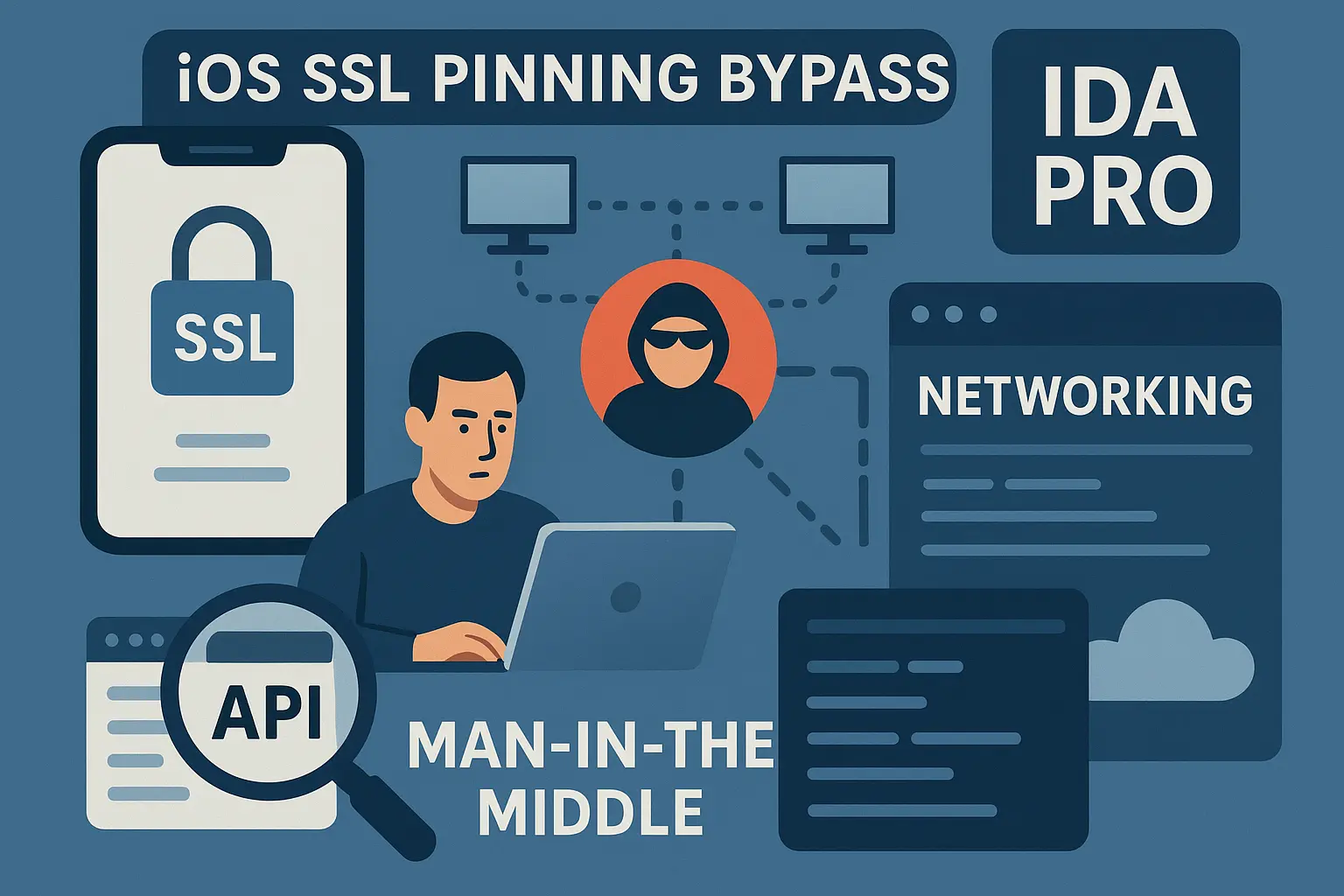
SSL pinning—also known as certificate pinning—is a security mechanism that forces an iOS app to communicate only with servers whose certificates match a pre-approved value embedded directly inside the app bundle. Rather than trusting the device's certificate authority (CA) store, a pinned app carries its own known fingerprint and validates it on every connection.
This defends against man-in-the-middle (MITM) attacks: even if an attacker positions themselves between the device and the network and presents a fraudulent certificate, the app will reject the connection because the pin doesn't match. Instagram, Threads, Facebook, and Snapchat all employ this mechanism to protect user sessions and sensitive data.
Security research into SSL pinning bypass techniques serves a clear purpose: it helps developers understand where their defenses can be pushed past, so they can strengthen them. Ethical researchers operate in controlled, isolated environments—not against live production users.
A public GitHub repository (culturally/Instagram-iOS-SSL-pinning-bypass) documents a binary patching approach to disabling SSL pinning in Instagram on iOS—without requiring a jailbroken device or a runtime instrumentation framework.
The method works by locating the specific functions within the compiled Instagram binary that perform certificate validation, analyzing their control flow at the ARM64 assembly level, and modifying the byte sequences responsible for the verification check. After patching, the app accepts any certificate presented by the server, allowing traffic to be intercepted with a proxy.
Decrypt the IPA — Extract a decrypted copy of the Instagram binary from the device (FairPlay encryption must be removed first).
Load into a disassembler — Open the binary in IDA Pro or Hopper, selecting the ARM64 processor module.
Locate SSL validation functions — Search for strings, known library symbols, or control flow patterns associated with URLSession certificate validation.
Analyze and patch — Replace conditional branch instructions (e.g., B.NE, CBZ) with unconditional branches or NOPs to short-circuit the validation logic.
Repackage and resign — Place the modified binary back into the Payload folder, compress to IPA, and re-sign with a developer or enterprise certificate.
Sideload and verify — Install on a non-jailbroken test device and confirm traffic flows through an intercepting proxy.
Several distinct approaches exist for bypassing SSL pinning in iOS apps. Each has different requirements, tradeoffs, and use cases:
Modifies the compiled binary before installation. Works on non-jailbroken devices. Changes are persistent. Requires disassembly skills and a re-signing step.
Dynamic instrumentation toolkit. Hooks SSL functions at runtime on jailbroken or developer-provisioned devices. No binary modification needed—changes exist only during the session.
Framework built on Frida. Automates common bypass tasks including SSL pinning disable. Simplifies the Frida workflow for security assessments.
A jailbreak tweak that disables SSL certificate validation globally or per-app. Requires a jailbroken device. Quick to apply but cannot be used on stock iOS.
The existence of functional binary patching techniques reinforces a fundamental principle in mobile security: SSL pinning alone is not a complete defense. It is one layer in what should be a multi-layered security architecture.
Developers building apps that handle sensitive data should layer the following defenses on top of certificate pinning:
Binary patching requires a meaningful level of expertise—disassembly skills, ARM64 knowledge, and a working re-signing setup. As a result, a parallel ecosystem of pre-configured, ready-to-install IPA files has grown to serve researchers and testers who want the outcome without the workflow overhead.
reversio.net offers a catalog of iOS applications where binary-level adjustments—including SSL pinning behavior and jailbreak detection bypass—have already been applied. Users receive a ready-to-sideload IPA without needing to perform the patching process themselves.
This reflects the broader maturation of the iOS security research community: as techniques become well-understood, tooling and pre-built environments follow, making the research more accessible to a wider audience.
Binary patching represents a sophisticated but well-documented approach to SSL pinning bypass on iOS—one that works without jailbreaks, Frida, or any runtime tooling. The Instagram case study illustrates both the accessibility of this technique for determined researchers and the gap it exposes in relying on SSL pinning as a sole security mechanism.
For developers, the lesson is clear: treat certificate pinning as one layer of a defence-in-depth strategy, not the final word. Obfuscation, integrity verification, runtime protection, and server-side monitoring together create a security posture that is meaningfully harder to defeat than any single mechanism alone.